Hunan Pork with Chilies
This post may contain affiliate links. Read our affiliate disclosure.
🧪 Developed & tested by the The Chowmi Test Kitchen for US kitchens. How we develop our recipes.
Hunan pork with chilies (辣椒炒肉, làjiāo chǎo ròu) is arguably the most-cooked home dish in Hunan, and a litmus test for a Hunan cook. It's exactly what it sounds like: thin slices of fatty pork stir-fried with a generous pile of fresh green chilies until the pork edges char and the chilies blister and soften. There's no thick sauce — the flavor comes from rendered pork fat, fermented black beans, garlic, and a splash of soy, with the chilies treated as a vegetable rather than a garnish. Authentic versions use Hunan's thin-skinned 'screamer' chilies, which are mildly hot and deeply savory; in a US kitchen a mix of Anaheim or banana peppers with a couple of jalapeños gets you close. It's smoky, spicy, intensely savory, and ready in about 20 minutes — the very definition of Hunan home cooking.
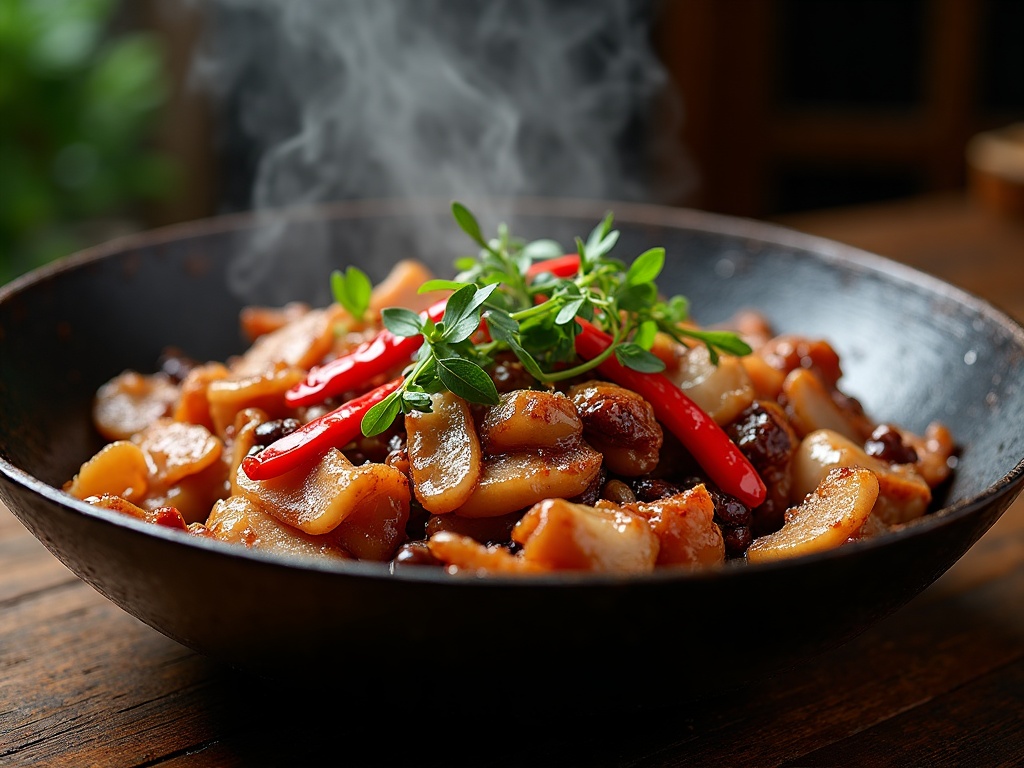 Save to Pinterest
Why you'll love this hunan pork with chilies
- The single most iconic Hunan home dish — smoky, fresh-chili heat with no heavy sauce.
- Just 20 minutes and one wok; the chilies are the vegetable, so there's little to prep.
- We tell you exactly which US-grocery chilies to mix for authentic flavor without blowing your head off.
- Rendered pork fat plus fermented black beans makes it deeply savory, not just spicy.
Ingredients
Pork & marinade
Chilies & aromatics
Sauce
Missing an ingredient?
AITell us what you have and what you're making — get the best US-grocery swap, with ratios.
Hard-to-find ingredients, delivered
Stock the pantry once and you can cook this anytime: Shaoxing wine, fermented black beans, dark soy sauce. Asian groceries deliver nationwide.
Equipment
- Wok or large skillet — You want high heat to char the pork and blister the chilies.(shop →)
Instructions
Marinate the pork
Toss the sliced pork with the light soy, Shaoxing wine, and cornstarch. Let it sit while you prep the chilies.
Prep the chilies
Slice the chilies on the bias into ½-inch pieces (scrape out some seeds if you want less heat). Slice the garlic and ginger; rinse and lightly mash the fermented black beans.
Heat 1 tbsp oil in a wok over high until shimmering. Add the pork in a single layer and let it sear undisturbed for 1 minute, then stir-fry until the slices are lightly browned and the fat starts to render, 2–3 minutes. Push to the side.
💡 Don't stir too soon — letting the pork sit gives you the browned, slightly charred edges that define this dish.
Bloom the aromatics
Add the remaining ½ tbsp oil to the center, then the fermented black beans, garlic, and ginger. Stir 20–30 seconds until fragrant.
Add all the chilies and stir-fry on high for 2–3 minutes, until they blister, wrinkle, and soften but still have a little bite.
💡 This is where the smoky 'wok char' on the chilies develops — keep the heat high and let them sit against the hot wok between stirs.
Season and finish
Add the light soy, dark soy, and sugar. Toss everything together for 30–60 seconds until glossy and combined. Taste a chili — it should be savory, smoky, and hot. Serve immediately with plenty of steamed rice.
Tips & notes
- The chili is the dish, not a seasoning — don't be tempted to cut the amount in half. Instead, control heat by choosing milder chilies (Anaheim, banana, Hatch) and keeping just one or two hot ones.
- Authentic 辣椒炒肉 uses Hunan 'screamer' chilies (线椒/螺丝椒). The closest US mix is long, thin-skinned mild green chilies plus a jalapeño or two for heat.
- Slightly fatty pork is essential — the rendered fat is what carries the flavor. Lean pork loin will be dry and miss the point.
- No fermented black beans? A teaspoon of doubanjiang (chili-bean paste) stirred in with the aromatics gives a similar savory-fermented depth.
- For extra smokiness (a Hunan signature), some cooks dry-fry the chilies in a dry wok for a minute first, then set aside and add back at the end.
Recipe wording too vague?
AIPaste any fuzzy step (少许, 火候正好, 焯水) and get exact amounts, temps and times.
Hunan Pork with Chilies
- Prep
- 10 min
- Cook
- 12 min
- Total
- 22 min
- Serves
- 3
- Level
- Beginner
Ingredients
- 12 oz skin-on pork belly, or pork shoulder, sliced thin (⅛-inch)
- 1 tsp light soy sauce
- 1 tsp Shaoxing wine
- ½ tsp cornstarch
- 6–8 fresh green chilies, mix Anaheim/banana peppers with 2 jalapeños; cut on the bias
- 2 fresh red chilies, Fresno or red jalapeño, for color (optional)
- 1 tbsp fermented black beans (douchi), rinsed, lightly mashed
- 4 cloves garlic, sliced
- 3 slices ginger, slivered
- 1 tbsp light soy sauce
- ½ tsp dark soy sauce, for color
- ½ tsp sugar
- 1.5 tbsp neutral oil
Instructions
- Toss the sliced pork with the light soy, Shaoxing wine, and cornstarch. Let it sit while you prep the chilies.
- Slice the chilies on the bias into ½-inch pieces (scrape out some seeds if you want less heat). Slice the garlic and ginger; rinse and lightly mash the fermented black beans.
- Heat 1 tbsp oil in a wok over high until shimmering. Add the pork in a single layer and let it sear undisturbed for 1 minute, then stir-fry until the slices are lightly browned and the fat starts to render, 2–3 minutes. Push to the side.
- Add the remaining ½ tbsp oil to the center, then the fermented black beans, garlic, and ginger. Stir 20–30 seconds until fragrant.
- Add all the chilies and stir-fry on high for 2–3 minutes, until they blister, wrinkle, and soften but still have a little bite.
- Add the light soy, dark soy, and sugar. Toss everything together for 30–60 seconds until glossy and combined. Taste a chili — it should be savory, smoky, and hot. Serve immediately with plenty of steamed rice.
Nutrition (est., per serving): 390 cal · 16 g protein · 9 g carbs · 33 g fat
Hunan Pork with Chilies FAQ
What is Hunan pork with chilies?
It's 辣椒炒肉 (làjiāo chǎo ròu), the everyday flagship dish of Hunan home cooking: thin slices of fatty pork stir-fried with a big pile of fresh chilies, fermented black beans, and garlic. There's no thick sauce — the chilies act as the vegetable, and the flavor is smoky, savory, and hot. It's so common in Hunan that it's used as a benchmark for whether someone can really cook.
Which chilies should I use in a US kitchen?
Authentic versions use Hunan's thin-skinned 'screamer' chilies, which are savory and only moderately hot. The best US-grocery approximation is a mix of mild long green chilies (Anaheim, Hatch, or banana peppers) with one or two jalapeños for heat. Use Fresno or red jalapeño for a few red pieces and color.
How is Hunan pork different from Sichuan twice-cooked pork?
Both use pork belly, but twice-cooked pork is simmered first, then fried with doubanjiang and sweet bean sauce for a glossy, deeply spiced finish. Hunan pork with chilies is a single quick stir-fry with no thick sauce, and its heat comes from a large quantity of fresh chilies rather than chili-bean paste. Hunan is drier, fresher, and smokier; Sichuan is richer and more numbing.
Can I make it less spicy?
Yes — keep the volume of chilies the same (they're the vegetable) but choose mild varieties like Anaheim or Hatch and remove the seeds and membranes. Add just one jalapeño, or none. You'll keep the smoky, savory character without overwhelming heat.
What cut of pork is best?
Skin-on pork belly is ideal for its layers of fat and meat, but thinly sliced pork shoulder (with some fat) also works well. Avoid lean cuts like pork loin, which dry out and don't render the fat that gives the dish its richness.
You might also like

Get our free Chinese Kitchen Starter Guide
The 12 pantry staples, the 5 techniques, and a week of beginner-friendly dinners — plus a new decoded recipe each week.
Comments
Made this? Have a question or a tweak? Share it below.
No comments yet — be the first!